Saturday, November 24, 2012

Prawirotaman, Batik Village


Prawirotaman is situated around 5 kilometers from the center of Yogyakarta City.

Prawirotaman is a village known since the 19th century when anoble of Kraton called Prawirotomo achieved a piece of land from the Kraton. from the beginning, the village played an important role for Yogyakarta. During the wartime, it was the concentration camp for the soldiers. After the wartime, it is renowned is the center of batik cap industry managed by Prawirotomo's offspring. In seventies during wich era the batik cap industry was declining, the Prawirotomo's offspring turned their business to the lodging services and since then on Prawirotaman has been well-known as the tourists' village. Although some has changed their manager, most are still managed by the Prawirotomo's offspring that consist of three big families, namely Werdoyoprawiro, Suroprawiro, and Mangunprawiro.

Sunday, November 18, 2012

Baliem Valley Festival

At last, the long-awaited Baliem Valley Cultural Festival (“Festival Budaya Lembah Baliem” in Indonesian) was at hand. We had scheduled our visit to coincide with the expected festival dates, not knowing exactly what day it would take place. The tourist office in Jayapura, when we had called from Surabaya, told us that it would be “before August 17” (and, surprisingly, they were correct.) In typical Indonesian fashion, we only found out the real date a few days beforehand. On the road to the festival location we passed groups of men dressed in full ceremonial costume. At the site, tourists and Papuans massed around a thatched grandstand in front of a large field. After hours of waiting, lavishly costumed Papuans carried in tied-up pigs and dumped them on the ground. Minor officials gave long-winded speeches under the blazing sun.


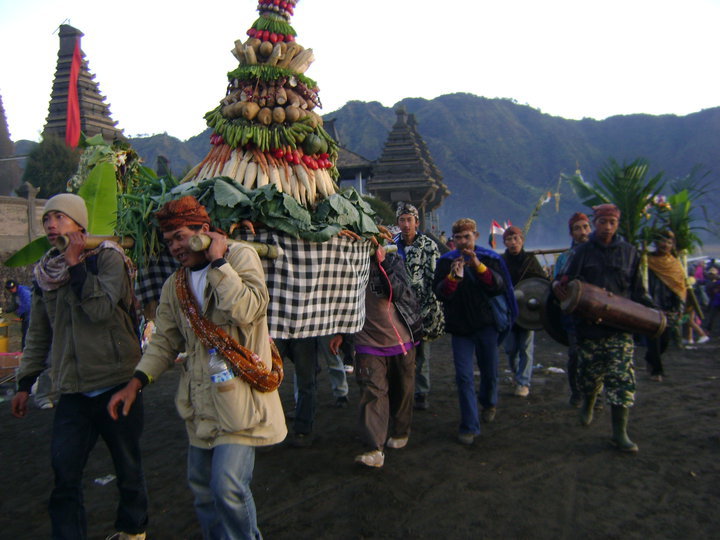
Yadnya Kasada Festival


The festival is the main festival of the Tenggerese people and lasts about a month. On the fourteenth day, the Tenggerese make the journey to Mount Bromo to make offerings of rice, fruits, vegetables, flowers and livestock to the mountain gods by throwing them into the volcano's caldera. The origin of the festival lies in the 15th century when a princess named Roro Anteng started the principality of Tengger with her husband Joko Seger, and the childless couple asked the mountain gods for help in bearing children. The legend says the gods granted them 24 children but on the provision that the 25th must be tossed into the volcano in sacrifice. The 25th child, Kesuma, was finally sacrificed in this way after initial refusal, and the tradition of throwing sacrifices into the caldera to appease the mountain gods continues today.


Tana Toraja and Their Unique Culture


The road from Makassar to Toraja runs along the coast for about 130 km's and then hits the mountains. After the entrance to Tana Toraja at the market village of Mebali one enters a majestic landscape of giant, gray granites and stones and blue mountains afar that form a sharp contrast with the lively green of the fertile, rain-fed terraces and the rusty red of the tropical soil. This is Tana Toraja, one of the most splendid areas in Indonesia.

Here, the nobility of Toraja are believed to be descendents of heavenly beings who came down by a heavenly stairway to live here on earth in this beautiful landscape.


Bunaken Marine Parks


Bunaken is an 8.08 km² island in the Bay of Manado, situated in the north of the island of Sulawesi, Indonesia. Bunaken forms part of the administrative city of Manado , capital of North Sulawesi. The marine Park around Bunaken is part of the  National Park that also includes the ocean around the island of  Manado Tua – or Old Manado, Siladen and Mantehage.